Design process (Duration : 1 weeks)
As a frequent user of super-apps, I read about Lineman's mission to "help Thai people live better" by providing convenience, creating jobs, and boosting local store revenue. As a UX/UI designer and Thai citizen passionate about positive social change, I decided to contribute to making Lineman the top food delivery app
Throughout the design process, we will go through four phases: Discover, Define, Develop, and Deliver
These phases will help us
uncover insights
identify the real problem
ideation of solutions
redesigning the user interface
How I enhance user experiences for all user type with subtle, powerful changes

Project background
Overall challenges:
How can we become people's preferred choice for food delivery services?
What improvements or new features can we implement to differentiate ourselves from the competitors?

a. Secondary research
b. 1:1 Interview
Secondary research - Take away:
#01
Demography, cultural norms, and personal goals is considered to be one of the factor that can lead to differences intrinsic and extrinsic motivations among individuals
People consistently assess and compare benefits and costs in most of their decision-making processes
People prefer it when better choices appear effortlessly, without them having to ask
Understanding people's cues, routines, and rewards can provide insights into their habits and help discover ways to create new ones
1) Self-Determination Theory (Deci and Ryan, 1985): It emphasise the role of intrinsic and extrinsic motivations that underlie human behaviour and decision-making. It drives individual differently. While intrinsic motivation involve enjoyment and personal satisfaction, extrinsic motivation arises from rewards and pressures
Intrinsic motivation
Extrinsic motivation
2) Nudge (Thaler and Sunstein, 2008): It suggests that small adjustment can significantly alter people’s behaviour. It encourage desirable decisions often through subtle changes. The aim is to nudge people towards making better choices, while still giving them freedom of choice
Small actions
Subtle changes
4) Cost-Benefit Analysis (Gary S. Becker, 1976): It’s a framework used to assess decision by comparing costs and benefits of choices of action. By weighing the positive and negative consequences of choices to determine whether the returns is efficient to the relative costs
Cost-benefit
3) The Power of Habit (Charles Duhigg, 2012): This theory explore how habits are formed, why they exists, and how they can be changes. Emphasising the role of cue, routines, and rewards in shaping behaviour
Cue
Rewards
Routines
In the first step in ‘discover stage’, my plan is to research the psychology and habit theories that drive and influence people in decision making and behaviour. This will help me gain a deeper and more comprehensive understanding of the factors affecting food delivery service's user behavior and the reasoning behind them
The key findings from secondary research were necessary and beneficial in helping me framing the 1:1 interview questions, ensuring that the gathered information really reflects the insights that is needed in the design process
I interviewed 5 individuals and conducted a user survey to gain a deeper, more detailed understanding of user insights on food delivery services. And here is an outline of the topics I covered during the interview

The key findings from secondary research were necessary and beneficial in helping me framing the 1:1 interview questions, ensuring that the gathered information really reflects the insights that is needed in the design process
I interviewed 5 individuals involving two user types (Lineman’s customers and drivers) to gather valuable insights for improvement. Since I believe that enhancing the user experience for both groups will lead to a more sustained overall user experience. And here is an outline of the topics I covered during the interview
their motivations to use the app
their app usage routine
the features or services that impress them
the benefit of using the app
the challenges of using the app
their current routine for resolving challenges
the improvements that they wish for
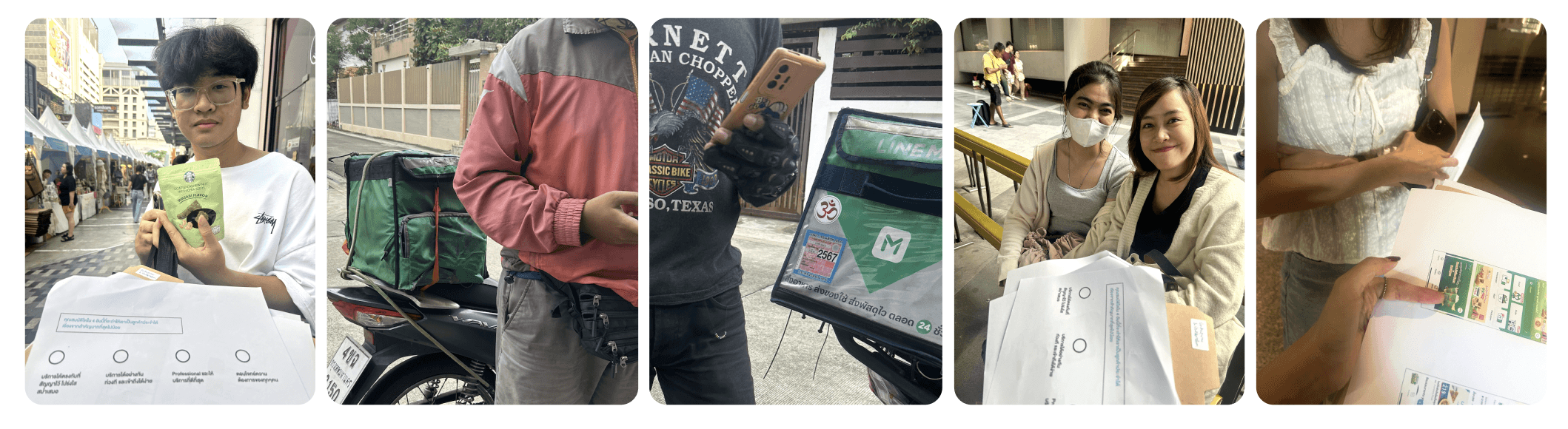
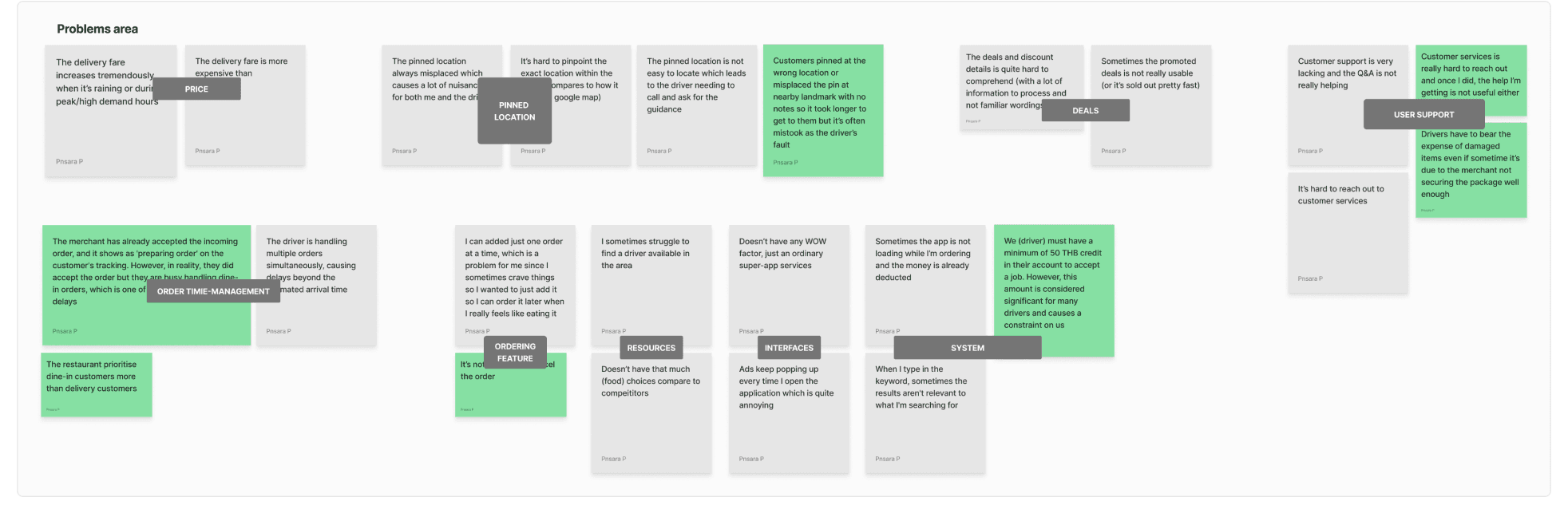
And to get a more comprehensive understanding of user insights, I conducted a user survey by using the same set of question and visualising it through affinity mapping
c. User survey (+affinity mapping)
I interviewed users aged 18-28 and drivers aged 40-50 who have worked with Lineman for 3-4 years. Users were generally happy with the app's interface and functionality and saw little difference between each delivery services. They found Lineman practical due to usable deals. However, drivers struggled with contacting customer support, restaurants prioritized walk-in orders over delivery, and difficulty finding restaurants in shopping malls, which is a major cause of order delays
1:1 Interview - Take away:
User type #01 : Customers
“There are many deals available, and they often work well”
“We usually hesitate to accept food orders from shopping malls because they take a lot of time and the restaurants are hard to locate.”
User type #02 : Driver

From the survey, we managed to gathered
insights from users aged 18-35, mostly female (73%). Most are company employees. Food
delivery usage varies from 1-2 times a week
to over 4 times a week.
While they prefer 'Grab' for car services, choice
for food delivery depends on current deals.
User survey and 1:1 Interview - Take away:
Lineman's strengths are its effective deals, user-friendly interface, and delivery status integration with the Line app, offering extrinsic motivation
and conveniences
In this second step in ‘define stage’, my plan is to synthesize the findings to clearly define user needs, problems, and goals. This will lead to a clear problem statement that will guide the design process further on
#02
At the end of the discovery stage, we concluded that for customers, the main drive of using the food delivery service are
'deals (functionality)' and 'convenience (usability).' For drivers, the primary focus is on 'convenience (usability)’
d. User persona
However, opinions on usability vary, with some finding the app easy to use due to its intuitive interface, others face challenges with the 'Pick-up location' and 'Deals usability'
Both customers and drivers find the
'Pick-up location' to be a common issue
After thoroughly understanding both user types, I created user personas based on quantitative and qualitative data gathered from all the processes. This will help to understand the users' motivations, routines, rewards, and pain points, guiding the design process to be user-centred


e. User journey
and conveniences
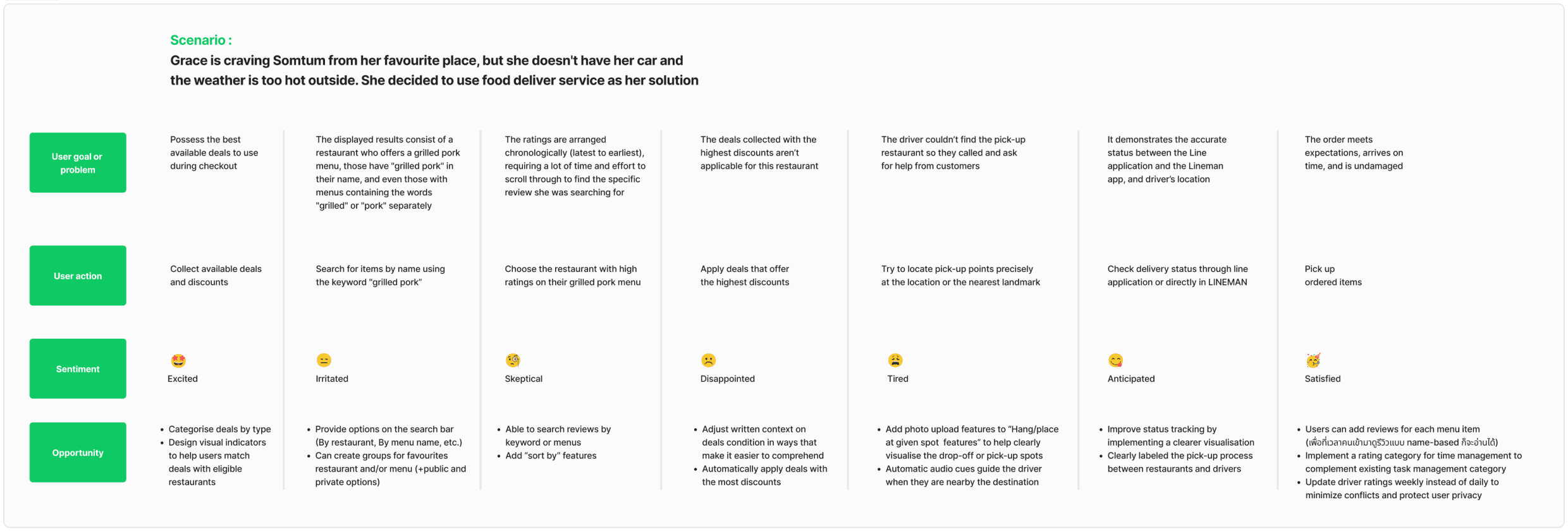
And once we have our user personas, I implement user journey mapping to gain a deeper, more empathetic understanding of user experiences. This method helps visualize the interaction and engagement between users and products/services at each step.
It also reveal opportunities that arise during each stage to create a seamless experience
They feel motivated to use the app if the deals are easy to use and practical, but if it’s not the case then they may become discouraged and lose overall confidence in the app
They wish for the search and reccommendations features to be more relevant, personalized, and customizable
They expect minimal interaction with the driver, as the current way of texting and calling although helpful but
they’re also bothersome and time consuming on both ends
They believes the reviews (most of the time) and usually order what others recommend
User survey and 1:1 Interview - Take away:
Conducting a competitive analysis after mapping user journey is crucial because it helps me understand insights within a broader context. While the user journey provides deep insights into pain points, the competitive analysis identifies how other companies address these issues and reveals opportunities for differentiation. This approach ensures that upcoming solutions are user-centered and strategically positioned
f. Competitor analysis


Sorting deals from highest to lowest discount is practical and time saving
The simpler the explanation of how deals work, the better
Reasonable fees significantly influence users' purchasing decisions
Accurate translations are highly valued by foreign users (Google Translate is a BIG NO)
Cash or coin rewards that can be used as discounts help create user routines and build loyalty
A personalised recommendations helps people save times on researching and browsing for their preferred options
Their primary motivation for using food delivery services is convenience
Competitor analysis - Take away:
After gathering a solid understanding of user insights, I use HMW questions to reframe pain points and insights from the user
journey and competitive analysis into design opportunities. These open-ended questions encourage creative thinking and
generate endless possibilities for solutions
g. How Might We
#03
In this third step in ‘develop stage’, my plan is to ideate on ideas to create potential solutions and focuses on generating and refining concepts to address user needs and problems
At the end of the define stage, we concluded that deals are the primary motivation for using the app. Users expect minimal
unnecessary interaction with drivers, while wishing for a more relevant, personalized search and recommendations as a reward to
enhance their dining experience
h. Brainstorming and Dot voting

Since I will be using brainstorming for ideation, I also implement the dot voting method to prioritize and identify the most
viable solutions. This helps me to determine what we should focus on now, what's next, and what we shouldn’t be executing at all

Brainstorming and Dot voting - Take away:
The most voted ideas are those associated with “Convenience.” These ideas received high approval because they reduce the actions or efforts required from users on doing things that benefits them or solving the existing problems. Additionally, users favoured ideas that would enhance their dining experiences
In the next steps, we will implement the selected solutions and map them onto the user flow. This will provide a broader perspective of user experiences after the adoption of those ideas, and ensure the entire experience is seamless and user-centered
Before sketching, I decided to use the information architecture process to create a structure that would guide the design of interfaces, ensuring they deliver all the selected solutions
i. User flow
j. Information architecture


After establishing the information architecture, I can now visualize the app's layout and flow. Creating paper wireframes allows for quick iterations, helping us see how these flows and solutions will look on the real interface before moving to more detailed designs
j. Paper wireframe

#04
In this last step in ‘deliver stage’, we will be presenting the refined and completed version of design to developers, conducting final testing, and ensuring all elements are ready for release to users
Creating a high-fidelity prototype after paper wireframes allows me to transform rough sketches into detailed, interactive designs. This step helps validate the visual design, user interactions, and overall user experience, ensuring the final product meets user expectations
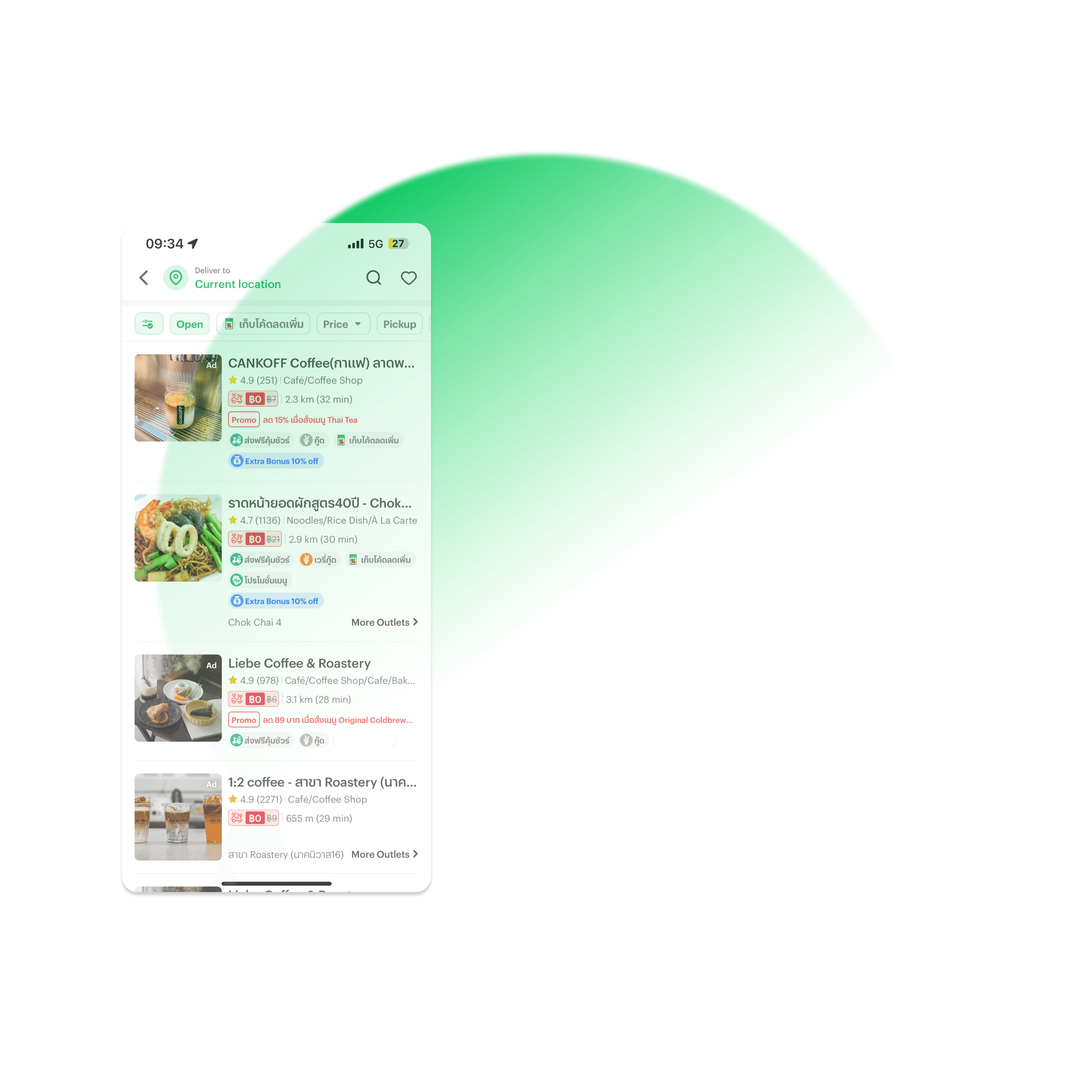
A redesigned interface that highlights deals, discounts, and other essential information, making it more comprehensible and easy on the eyes
Deals and Information

k. Hi-fi prototype
Highlight the essential details users need and want to know, while using consistent visuals to help them understand which deals apply to certain restaurants and which do not
Coupon(deals) book


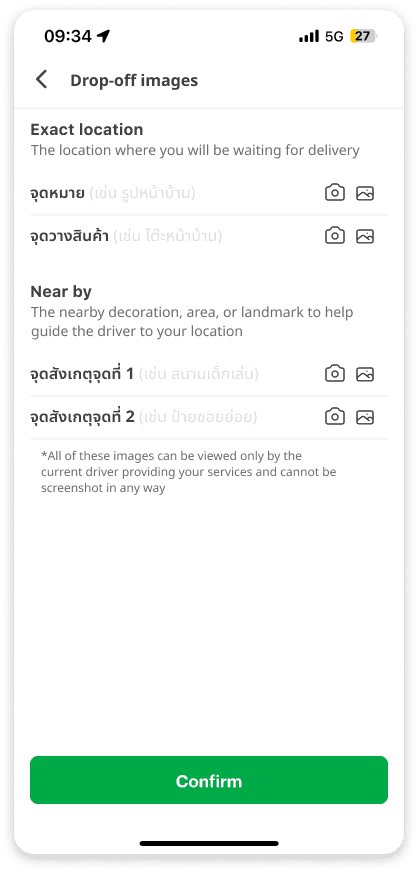
Clearer instructions improve efficiency. I added visual elements to the delivery info feature for both pick-up and drop-off to save time and reduce communication between customers and drivers
This is especially helpful for pinpointing restaurants in malls, which can be time-consuming for drivers
Pick-up and drop-off location info


Users can edit their order within 2 minutes after placing order, providing flexibility and reducing the chances of customers and drivers having to address changes independently
Edit order


Meal-based review feature allows users to read individual menu item reviews for precise, personalized insights.
Added more options to the existing feature to enhance users' dining experiences and provide more relevant search results with minimal effort
Meal-based review
Customise favorite
And finally, a little something extra: Spin the Wheel
food challenges!


For the final step, I had both user types look through the prototype and provide constructive feedback for future improvements. Here are some quotes from their experiences:
For the next step, I'll focus on simplifying and prioritizing content to ensure it remains effective and delivers the necessary information. I may also explore which information is essential and what might not be needed. Additionally, I believe that talking to the drivers provided valuable insights, so I plan to dive deeper into their perspectives to make Lineman Wongnai an app that suits their needs as well
l. User Feedback
Next steps
The deal visualization is easier to comprehend and eye-catching, but the content is still a bit messy. I wish it were cleaner
The added pick-up info will be very useful, as drivers often call for directions, which can be tiresome for the both of us
“Both users and drivers would like the ability to edit orders within 2 minutes, though it might complicate things for restaurants”
I like the feature where you can read reviews for each menu item, it helps users decide on meals faster
“The added pick-up info feature would make drivers more willing to accept mall orders”
driver

